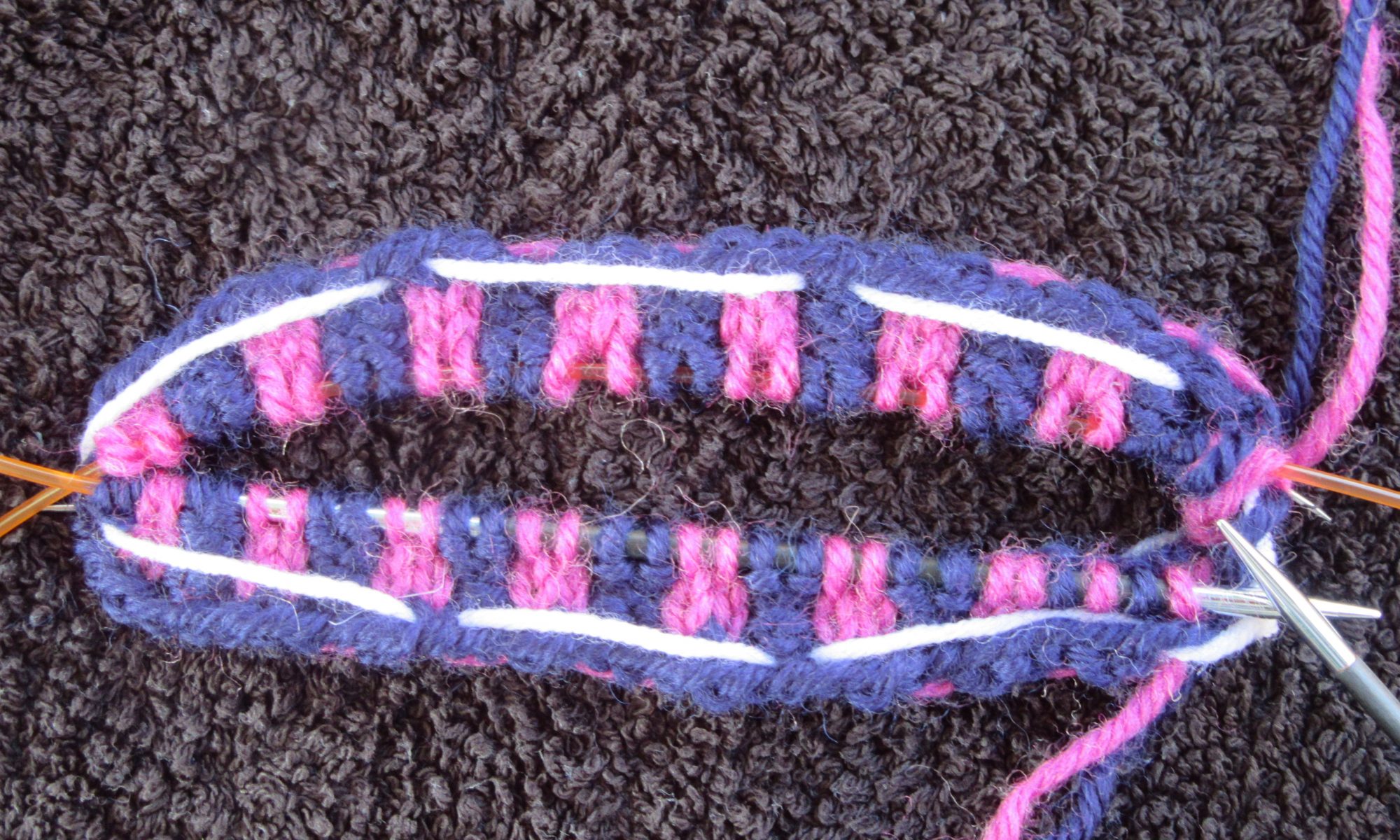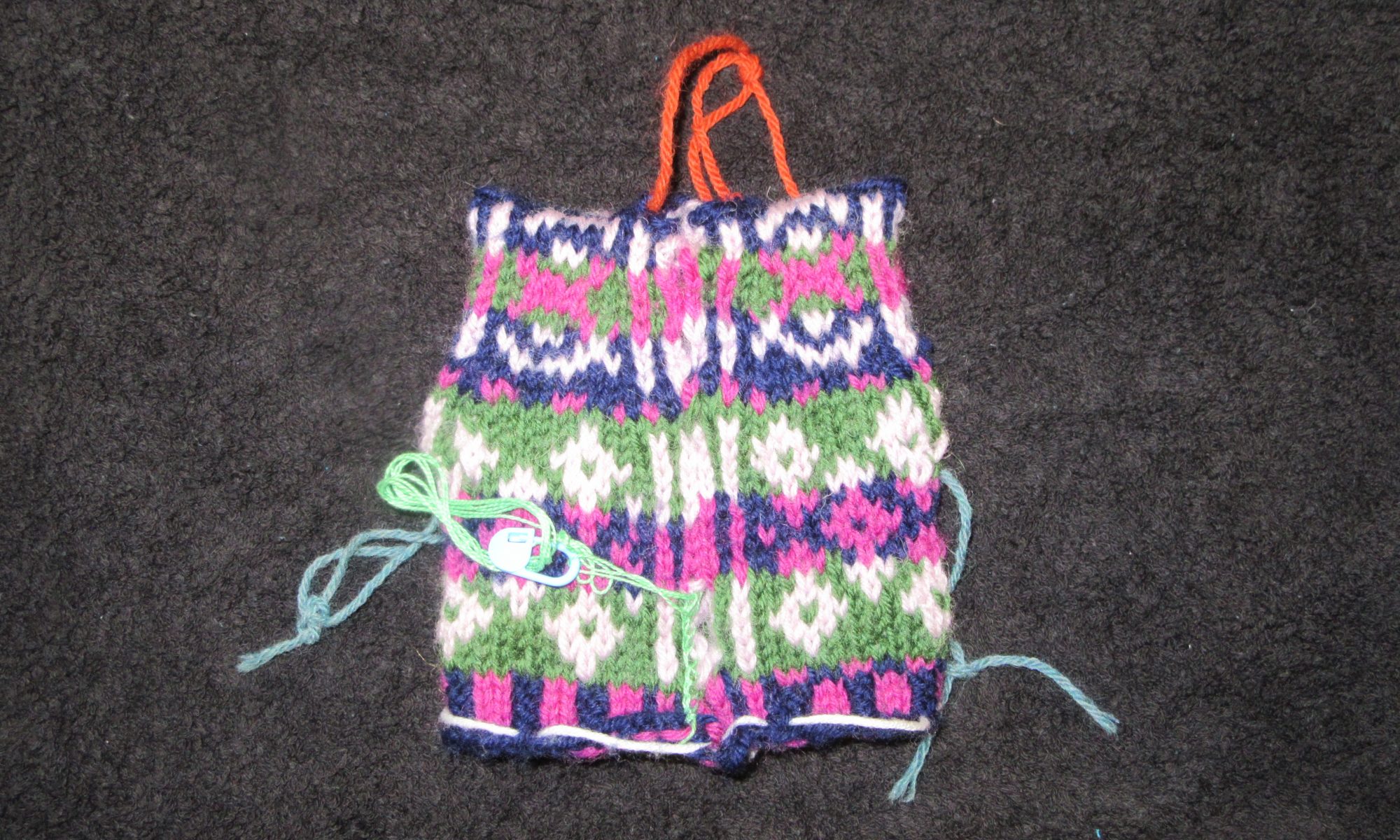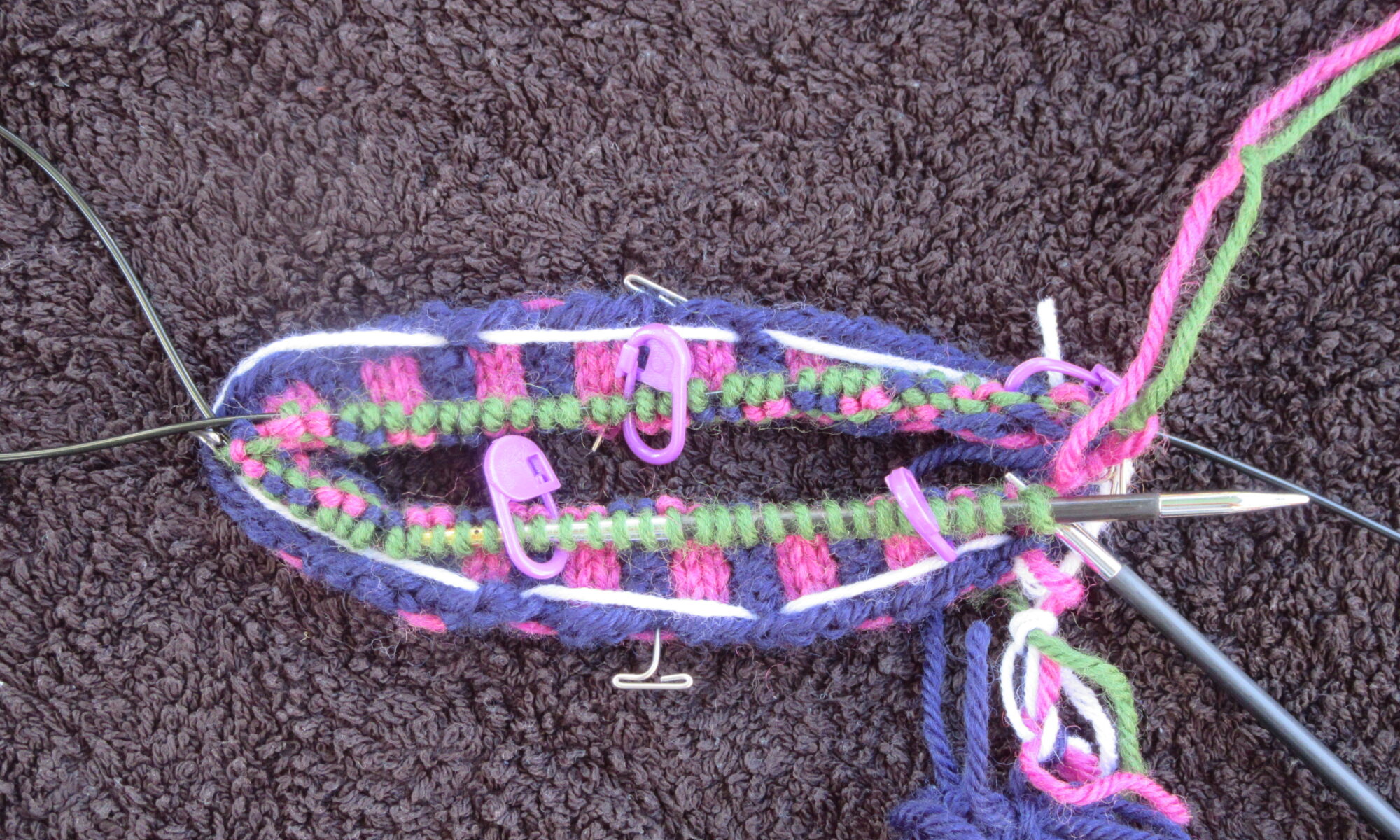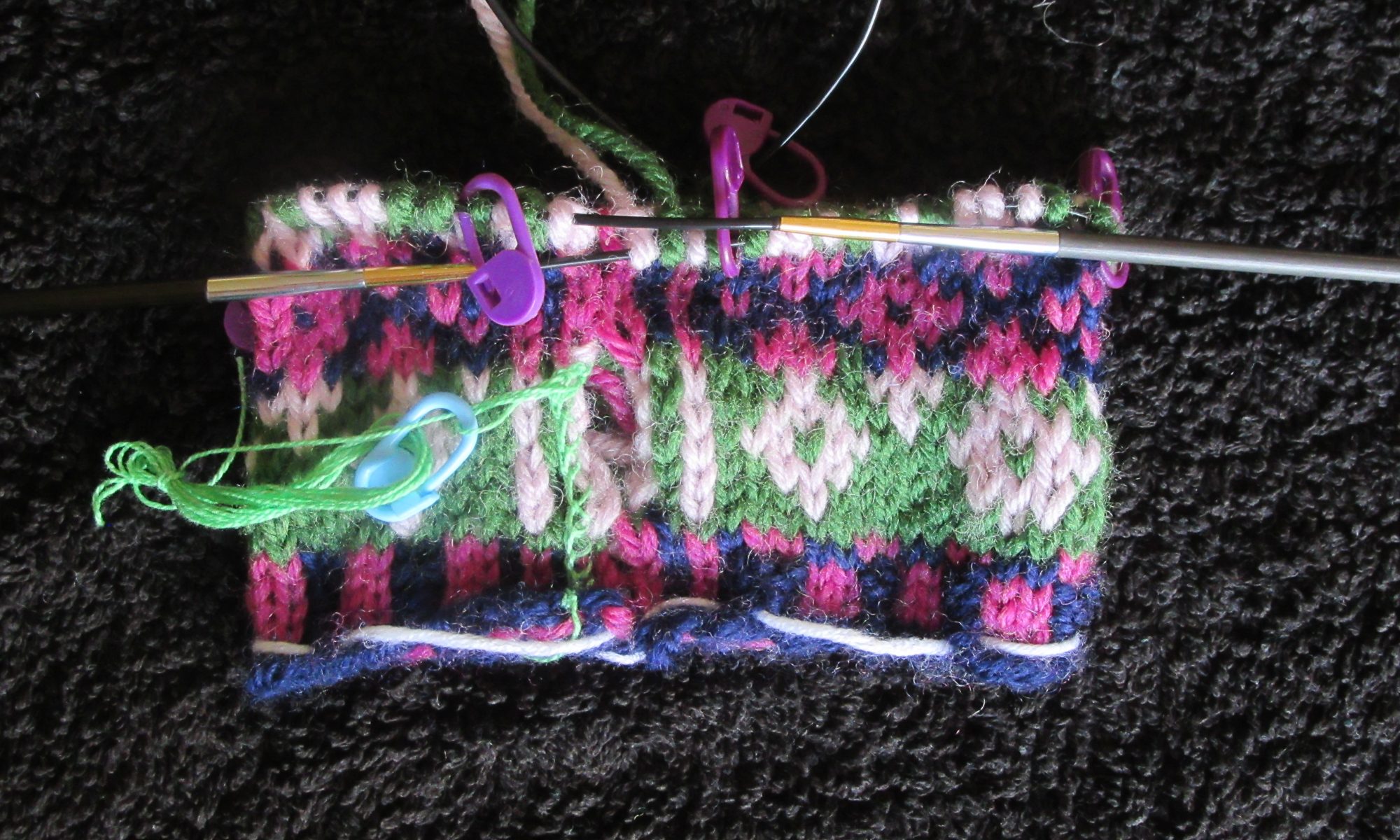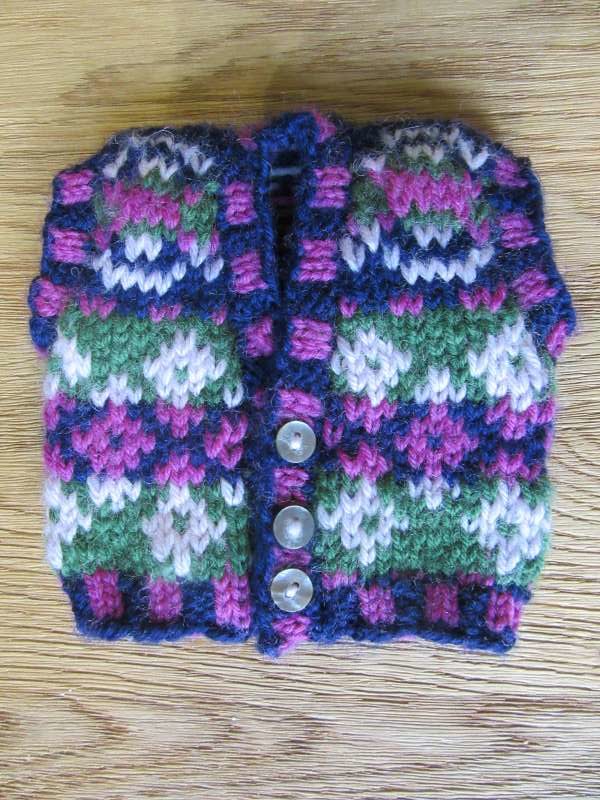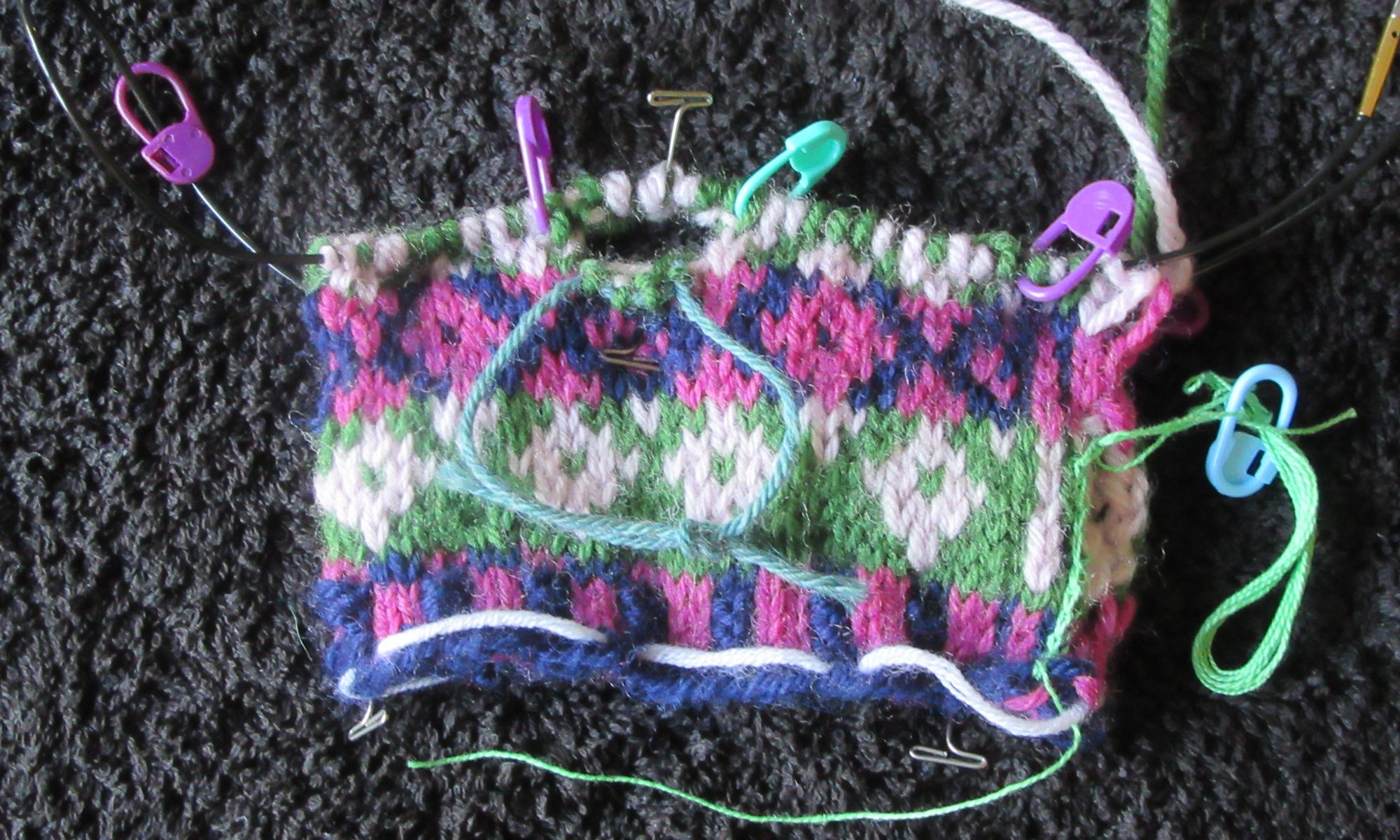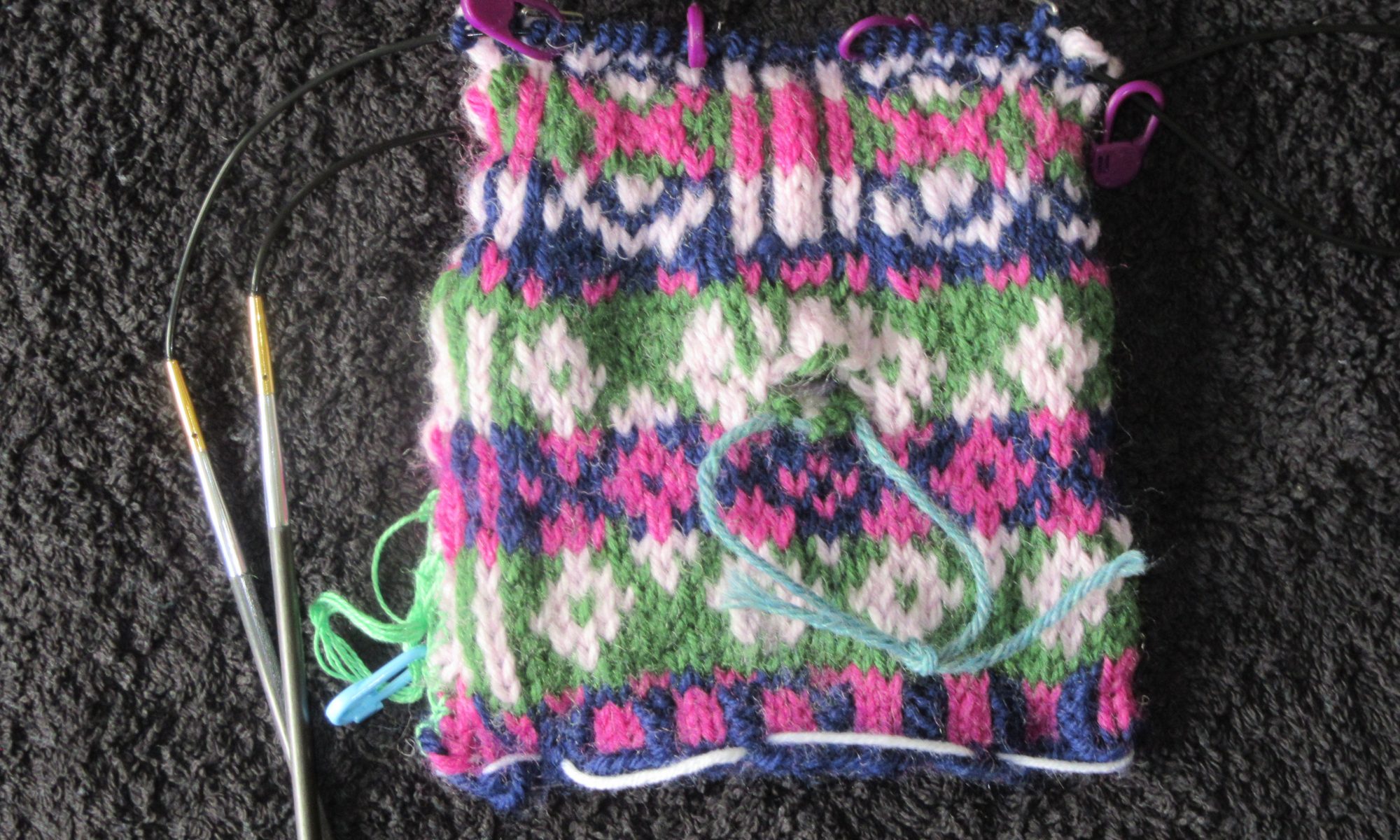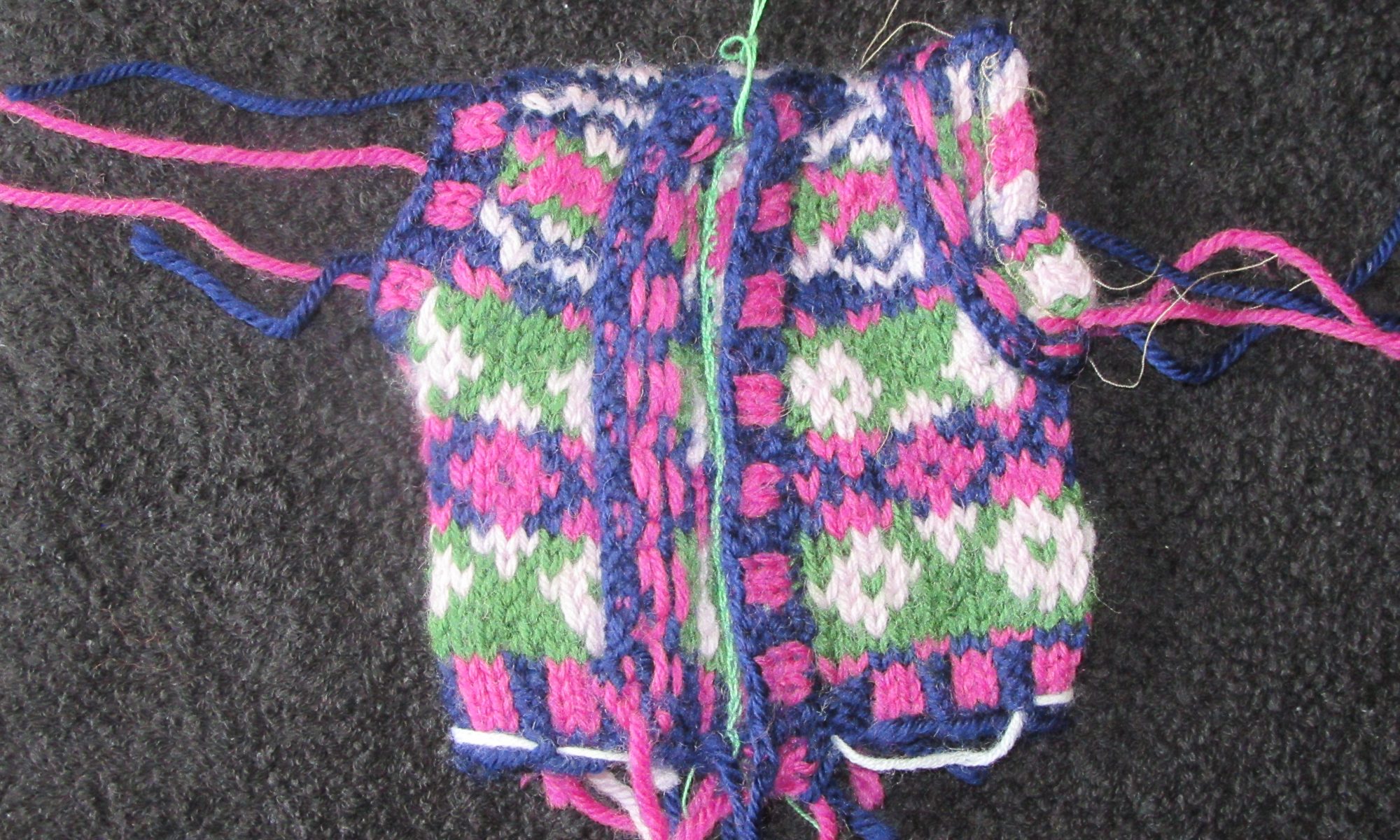

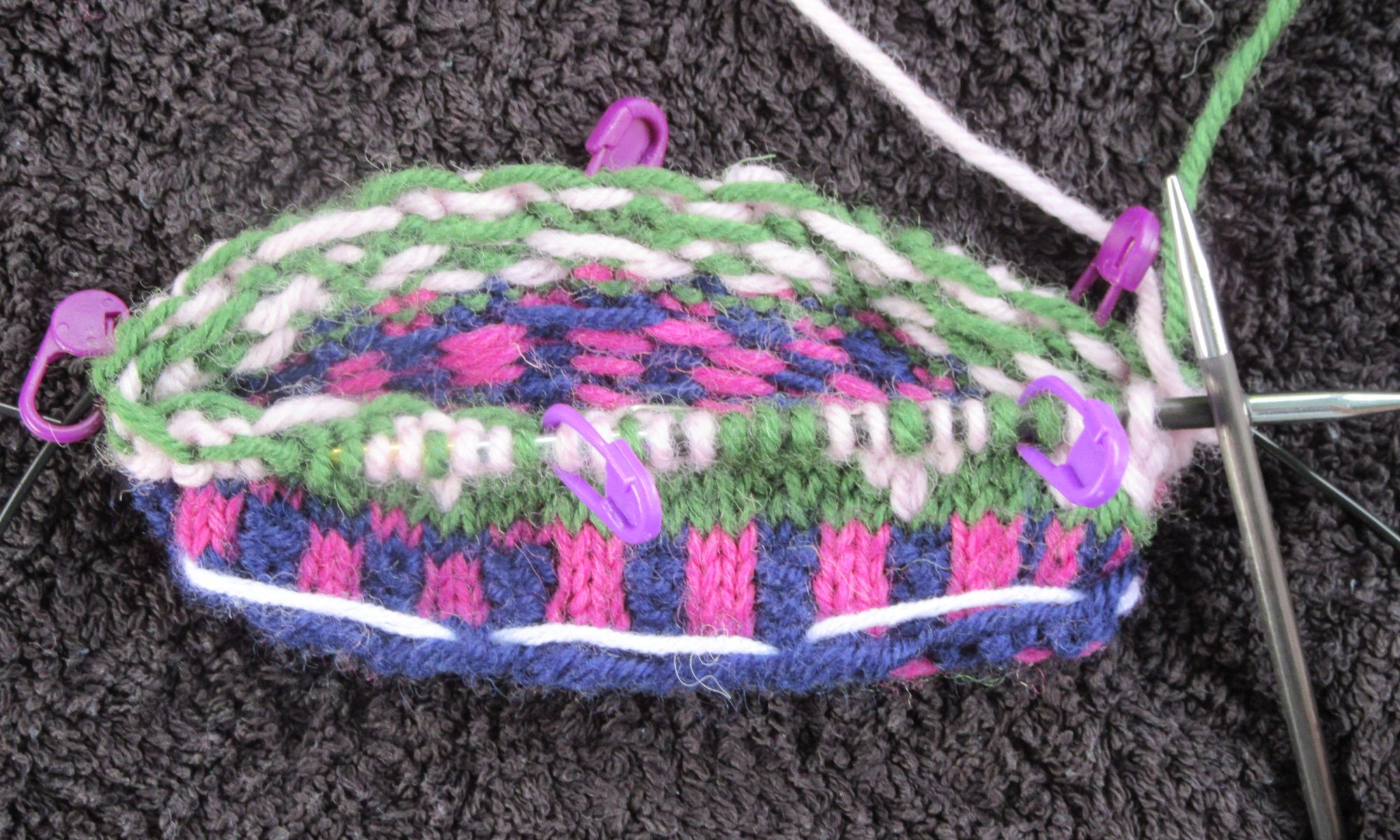
Most people follow a pattern when they are knitting. Knowing how to match the instructions in the pattern to what you see as the fabric is formed on your needles is central to reading your knitting.
Continue reading “Matching what you see to the pattern”Stitch markers
Introduction to stranded colour work tutorial – Activity 7
Activity 7: Start steeks for armholes
You should have completed Activity 6: Knit in the round to the armholes and completed round 14 of the chart.
A steek lets you keep knitting in the round, even when there will be an opening in the finished item. You already have one steek at the beginning of each round that will form the opening at the front of the waistcoat. In this activity you will create two more for the armholes.
Continue reading “Introduction to stranded colour work tutorial – Activity 7”Introduction to stranded colour work tutorial
Introduction to stranded knitting tutorial
Learn the basics of stranded colour work in this stranded knitting tutorial. You will learn how to knit with two colours and to follow colour charts. Armholes and V-necks will be easy after you learn how to cut a steek. So, if you want to learn at your own pace, this is the tutorial for you.
In addition, the companion “Introduction to stranded knitting workshop” covers the same material in a series of online meetings. You might want to take that workshop if you would like feedback on your progress, for example.
Contents of this workshop
This tutorial uses a practical project to make a miniature stranded colour work sleeveless cardigan. This tutorial guides you through the skills you will need:
- Cast on for knitting stranded colour work in the round.
- Hold yarn for knitting in two colours.
- Knit stranded rib (also known as cartridge rib).
- Read types of chart used for colour work.
- Knit stranded colour work in the round using stocking stitch (knit stitches only).
- Catch your floats to avoid long loops and give even tension.
- Knit colour work “flat” in stocking stitch (using both knit and purl stitches).
- Make decreases in a colour work pattern.
- Pick up stitches along the edge of a steek.
- Prepare and cut a steek.
Skills you will need before starting this tutorial
To understand this tutorial, you need to be able to:
- Cast on.
- Knit and purl.
- Knit in the round using circular needles or double pointed needles.
- So that you can knit this small item with circular needles, you need to use the magic loop (or travelling loop) or two circular needles.
- Decrease using right-leaning (k2tog) and left-leaning (ssk or sl1 k2tog psso) decreases.
- Pick up and knit stitches from the sides and top of knitting.
Let’s get started
Work through these activities to knit your own sleeveless waistcoat for a cuddly toy. You will need to download the handout for this workshop that contains the chart and pattern, as well as useful tips.

Yarn and tools
Start by gathering together the yarn, notions and tools you will need.

Activity 1: Vertical stripe rib
Cast on and knit the vertical stripe rib.

Activity 2: Knit in the round
Learn how to read a chart and to knit with two colours in the round.

Activity 3: Catch floats
Learn how to catch floats when working on the public side. This avoids long floats, and helps keep even tension.

Activity 4: Knit stranded colour work flat
Learn how to knit stranded colour work using knit public side and purl private side rows.

Activity 5: Reinforce your first steek
Learn how to hold the steek stitches in place before you cut them.

Activity 6: Continue in the round
Now that you can knit both flat and in the round, continue until you start shaping your waistcoat.

Activity 7: Cast on for steeks
Learn how to add extra stitches for the steeks to prepare for shaping your fabric.

Activity 8: Complete the main body
Learn how to decrease while following the chart.

Activity 9: Bind off and join the shoulders
Prepare your waistcoat for adding the arm- and button-bands.

Activity 10: Reinforce steeks
Reinforce all your steeks ready for cutting.

Activity 11: Pick up and knit the bands
Learn how to pick up stitches for the arm- and button-bands and then knit the bands.

Activity 12: Finishing
Learn how to cut the steeks. Then sew in the ends and “dress” your waistcoat.

Activity 13: Congratulations
Now you have finished your waistcoat, sit back and admire your work.
Introduction to stranded colour work tutorial – Activity 1
Activity 1: Vertical stripe rib
Before you start, please make sure that you have done everything in Activity 0. For instance, have you downloaded the handout and have the yarn and tools listed in Activity 0.
Instructions for this activity are on page 6 of the handout. You do not need to swatch for this project because its size does not matter. Instead, you can treat the entire project as a swatch to practice. Then make another one if you want to have a “showcase” to show others.
Continue reading “Introduction to stranded colour work tutorial – Activity 1”Introduction to stranded colour work tutorial – Activity 6
Activity 6: Knit in the round to the armholes.
You should have completed Activity 5: Reinforce first steek.
This activity is on page 14 of the handout.
Continue reading “Introduction to stranded colour work tutorial – Activity 6”Introduction to stranded colour work tutorial – Activity 5
Activity 5: Reinforce first steek
You should have completed Activity 4: Knit stranded colour work when knitting flat and have knit 8 rounds of the motif (three of these knit flat).
Rather than continuing to knit the motif, we will take a break and learn another new technique – reinforcing a steek. Normally, you would only reinforce the steek when you had finished knitting the garment. But this is a tutorial, so I will concentrate on teaching you new things, and then letting you go off and practice them.
Reinforcing a steek
The instructions for this activity are on pages 12 and 13 of the handout. You need to remember where you have put the crochet hook and the thinner yarn!
The video shows you how to reinforce a steek.
You have an even number of stitches in your steeks, so you will be joining the two central stitches of the steek to their neighbours.
Follow the instructions on pages 12 and of the handout to reinforce the steek at the ribbing and first five rows of the motif. This takes you from the cast-on edge to where the steek is split because you knit flat.
When you have finished you should see two neat crochet chains either side of the beginning/end of round.
Go on, give in to temptation
If this was a real project, I would strongly advise that you do not cut the steek until you have picked up the stitches to form the arm and neck bands. But this is a tutorial, and it’s only a small piece, isn’t it? If you want, you can cut the steek now.
You are ready for the next activity

If you resisted temptation, your work should look something like the photograph.
You are ready to move to the next activity: Activity 6: Knit in the round to the armholes.
Additional links
Introduction to stranded colour work tutorial – Activity 3
Activity 3: Catch floats on the knit side of the work
You should have already completed Activity 2: Knit stranded colour work in the round and have competed 2 rounds of your motif.
In this activity you will learn how to catch (trap) floats when you are knitting on the public side of stranded colour work. Catching floats helps maintain an even tension. Shorter floats are also less likely to catch in fingers.
The instructions for this activity are on page 9 and 10 of the handout.
Continue reading “Introduction to stranded colour work tutorial – Activity 3”Introduction to stranded colour work tutorial – Activity 9
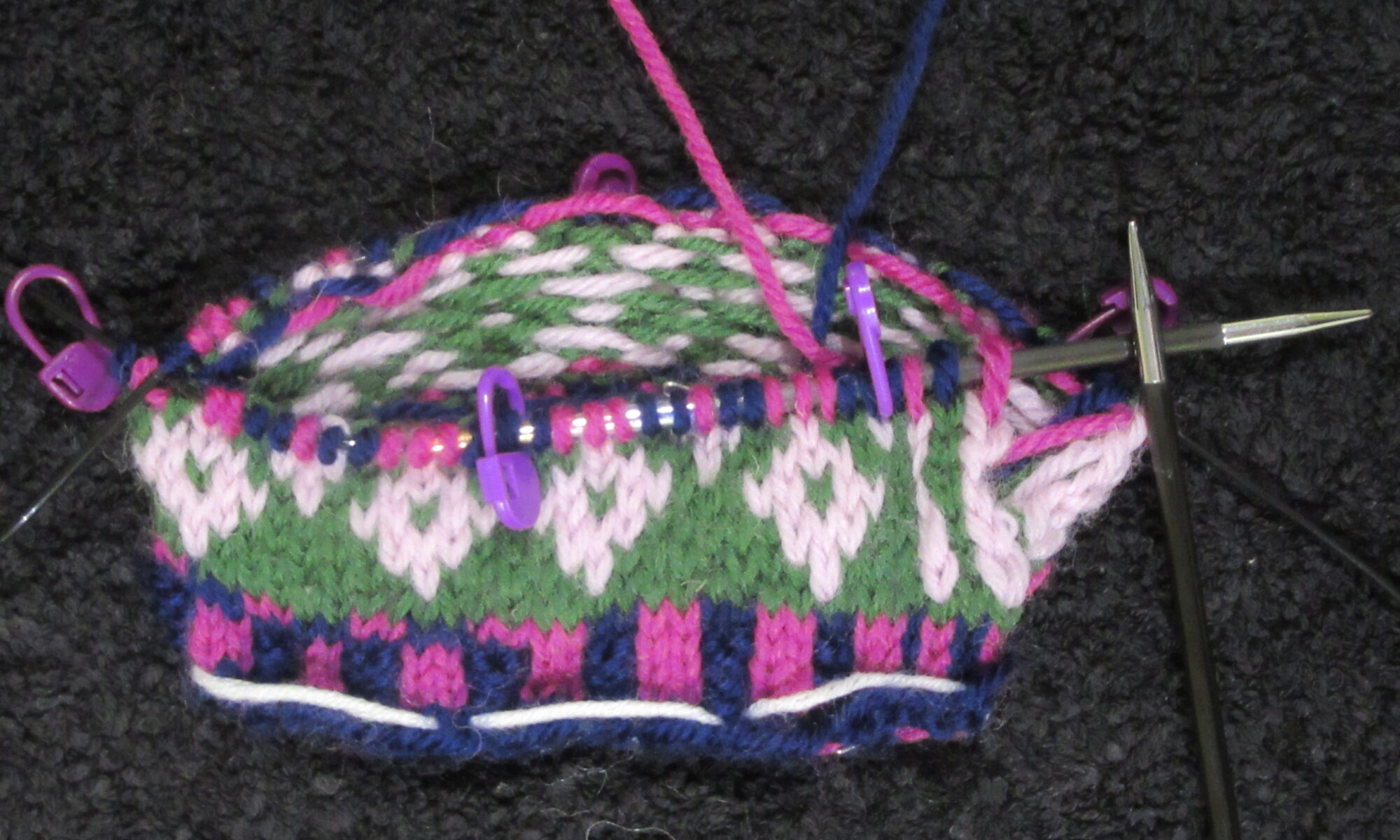
Activity 9: Bind-off and join shoulders
You should have completed Activity 8: complete the main body of the waistcoat.
In this activity, you will join your work at the shoulders, leaving the neck open. Instructions for this activity are on page 19 of the handout.
Continue reading “Introduction to stranded colour work tutorial – Activity 9”Introduction to stranded colour work tutorial – Activity 2
Activity 2: Knit stranded colour work in the round
You should have already completed Activity 1: Vertical stripe knitting and have 3 rounds of vertical stripe ribs.
In this activity you will learn how to read a chart for colour knitting and practice knitting with two colours at a time to create a motif.
Continue reading “Introduction to stranded colour work tutorial – Activity 2”